As a college language educator, I have found limited training sessions on effective (based on research) instructional technology tools in elementary and intermediate language courses. Even though Technological Pedagogical Content Knowledge (TPACK) philosophy is reflected in The Partnership for 21st Century Skills (P21) – World Languages, language educators still do not incorporate appropriate technology tools in their courses. This matter has been more visible during these past years due to the increased demand for online courses.
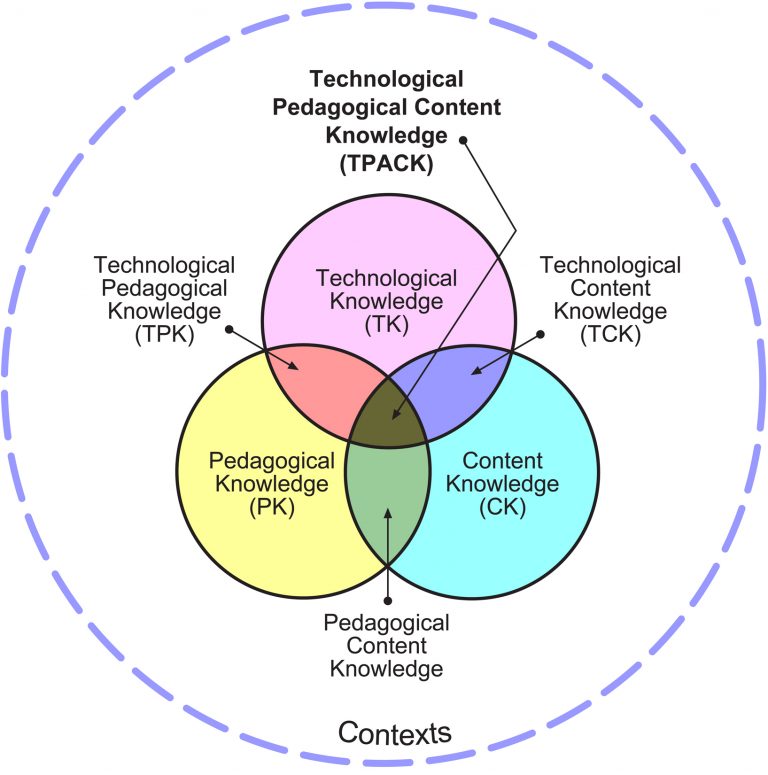
This online workshop aims to improve TPACK competency for language educators. In addition, the site provides resources to support the creation of practical online language activities in a constructivist environment by collaborating with their peers.
The 1-day workshop has a linear sequence. Therefore, participants start with the “Start Here” section and follow the suggested order (modules 1, 2, 3, and 4). The first module focuses on language pedagogy. This section briefly reviews American Council on Teaching Foreign Languages (ACTFL) standards, the Integrated Performance Assessment (IPA) format, Can-ACTFL Proficiency Levels, and Can-Do statements. The second module assesses participants’ TPACK competence level by taking a survey. After that, the module covers the TPACK framework, its impact on ISTE standards, and the 21st Century Skills Map for World Languages. The third module introduces the SAMR, DoK models, and the CoI framework to assess instructional tools and their affordances. Finally, in a constructivist approach, the fourth module allows participants to work on specific lessons using the Backward Design method, the TPACK-in-ACTION model, and the Lesson Plan Template.
The learning outcomes are:
- Describe and use standards and best practices for teaching languages
- Explain the TPACK framework, its impact and assess the TPACK competency level
- Assess instructional technology tools by using different models and frameworks
- Design lesson plans by using the Backward Design approach and the TPACK-in-ACTION process
If you are interested in participating in this workshop, contact me on LinkedIn.